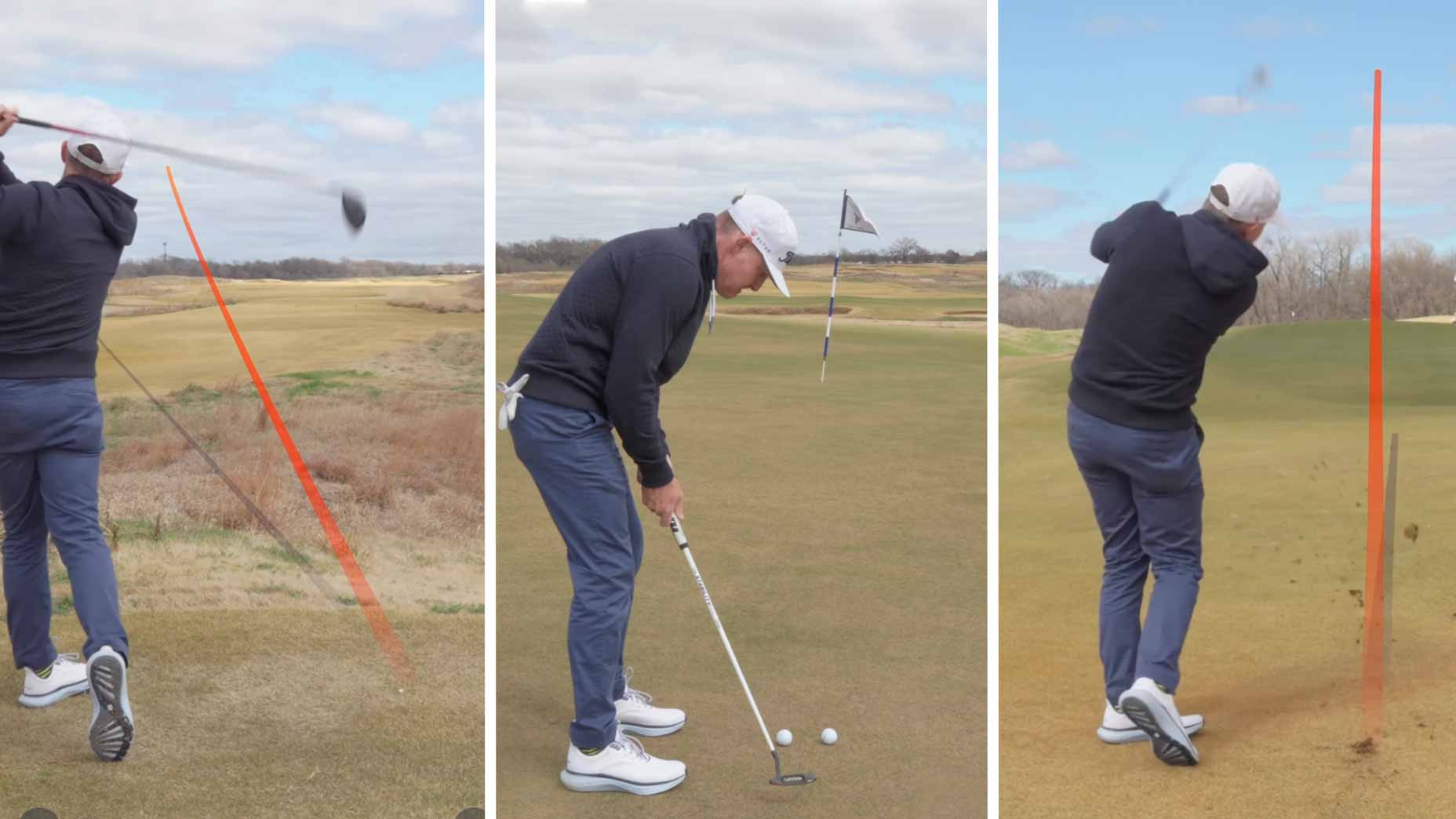


I was using blades like that and seeing improvements, especially from short and mid-range, until Scotty Cameron released their Onset Center Fastback and Phantom 11R, the company’s first low-torque putters. Immediately, I was intrigued, especially by the Fastback OC, as it was a shape that I already knew I liked — a mid-mallet that was far off spaceship territory — had little shaft lean and had Scotty Cameron’s new and very soft Studio Carbon Steel insert.
Scotty Cameron Studio Style Fastback OC Putter
As an extension of the popular Studio Style Fastback design, the Studio Style Fastback OC is a low-torque model featuring the same ring-weighted, high-alignment, multi-material design of the other Fastback models, but with Scotty’s tour-validated OC technology package. Featuring onset center shaft placement behind the putter face’s leading edge, the straight shaft is precisely positioned in line with the putter head’s CG location and leans 1° forward. This allows for low-torque performance and face alignment that stays square to the path.
STUDIO CARBON STEEL (SCS) FACE INSERT
The Studio Style Fastback OC includes a chain-link milled Studio Carbon Steel (SCS) insert for soft sound and feel, treated with an electroless nickel plating for enhanced durability with aerospace-inspired vibration damping for tuned sound, feel and performance.
CUSTOM BLACK SHAFT
Custom made for the new OC putters, each model includes a special black KBS x Scotty Cameron shaft with optimal flex, unimpeded alignment and precise feel.
CUSTOM MATADOR GRIP
With a debossed chain-link texture built-in, each new OC putter includes a custom 11-inch mid-size Matador grip in black with racy red and cool gray accents.
View Product
ALSO AVAILABLE AT: PGA TOUR Superstore, Titleist
In my first tests, I didn’t have a left miss, which to that point, I’d experienced with almost every low-torque putter I’d tried except the Spider ZT. I put some impact tape on the face just out of curiosity and saw my strike was dead center.
Jack Hirsh/GOLF
That was when I came up with this experiment, and my experience at the Kingdom only further proved to me that I was on the right track.
For the next few months, I planned to putt exclusively with low-torque putters as a means of resetting my putting stroke.
Until my putter fitting with Bettinardi, I felt like my putting was holding me back. I struggled big time with pulls, especially from short range and couldn’t convert enough 10-20 foot mid-range putts. I started putting better after the putter changes, but I figured, why not try to reset everything and potentially start fresh in 2026?
After TaylorMade, I wondered if the experiment would ever end. But by April, it was, and I had learned a ton.
My results with low-torque putters
The primary putters I used for the experiment were the Scotty Cameron Fastback OC and the Spider ZT, both at 35″ and standard lie angles of 70 degrees. I also dabbled with a L.A.B. Golf OZ.1i and had some good initial success, but the milled steel insert was too firm for me, and I struggled with pace.
The blade putters I used in 2025 were slightly longer at 35.5″ and flatter at 67 degrees, but with both putters, my stroke was consistent and my eyes were in similar positions in the stock length and lie.
Both putters I gripped with the Golf Pride Reverse Taper Pistol Medium, slightly larger than the small version I’d been using on all my other putters. I did this because, to be most effective with a low-torque putter, I needed to remove my hands from the stroke, and a bigger grip helps that.
At first, the results were good. I trended toward the Cameron a little more because of its more compact shape and the softer insert, which I felt helped with distance control.
The Spider ZT had plenty of advantages, though, thanks to its larger, high-MOI shape. With that putter, I knew I could make a bad stroke and still have it go in.

TaylorMade Spider 5K-ZT Black Putter
LOW TORQUE DESIGN
The KBS putter shaft is bored directly toe-ward near the CG at a 1° shaft lean with 25mm onset behind the face allowing golfers to realize the benefits of a new stable, toe up design.
UNIQUE SOLE SHAPING
New and improved sole shaping to work specifically with this unique hosel configuration, engineers worked tirelessly to find new ways to improve accuracy from the moment the putter is placed behind the ball. The new sole curvature accommodates different player types and ball positions, giving golfers the ability to find a consistent and repeatable stroke.
SPIDER STABILITY
Combining high density stainless steel and low-density aerospace quality aluminum provides the perfect foundation for a design that is high MOI and allows for a shaft orientation that sits closer to the face.
MILLED TRUE PATH™ ALIGNMENT
Based on tour player feedback, we were tasked to find a new premium alignment system. Building on the classic TaylorMade True Path™ technology, milled lines the width of the golf ball were added helping golfers properly index to center face.
View Product
ALSO AVAILABLE AT: PGA TOUR Superstore, TaylorMade
For the most part, my pulls on short putts, especially right-to-left breakers, were eliminated, but I didn’t realize at what cost for a few months.
Eventually, my left miss came back because I became fearful of a right miss. The thing with low-torque putters is that they resist the urge to twist either direction. I’ve putted for years with the feeling of the blade opening and then closing. Whether it matched my stroke or not, I needed to feel like the blade closes through the stroke.
This is when I got into a phase of battle golf on the green, either pushing the putt because I was actively trying to avoid feeling my natural release through the putt, or pulling it because I forced myself to close the blade, even though the putter was already square.
I had grown up on a feel and now that feel was dulled.
What I’m using now
Ironically, the putter I’m using now was presented to me during Fully Fit, and I passed because I didn’t understand what it was.
The Ping Scottsdale TEC Ally Blue Onset looks like a low-torque putter, but it’s actually something entirely different. For starters, the Ally Blue Onset has toe hang. It’s minimal, just five degrees, but the toe does not point up when balanced.
That’s because instead of aligning the Ally Blue Onset’s shaft through the center of gravity of the putter, Ping placed it in front of the CG, meaning the stroke pulls the CG, like a truck towing a trailer. The configuration does lower the putter’s torque profile, but it’s not far off from Ping’s Anser either.

PING Scottsdale TEC Ally Blue Onset Custom Putter
View Product
ALSO AVAILABLE AT: PGA TOUR Superstore
The shaft is still back off the face, but it gives a completely unobstructed view of the face to aid alignment. The Scottsdale TEC EyeQ technology also has a number of alignment aids built in that GOLF’s Jake Morrow just dove deep into.
With that unique CG placement relative to shaft axis, what I got is a super stable putter that gave me just the right feeling of release through the ball. Finally, I had a putter that I could stroke freely and trust the ball would come off on my intended line.
The Scottsdale TEC insert is made of super-soft PEBAX material. It’s the first non-milled putter I’ve ever used, but the soft feel is very similar to what I’ve liked my whole life.
When at Ping’s PLD Putting Lab for my fitting last December, the fitter asked if I wanted to try the then-unreleased Ally Blue Onset. I thought it was another low-torque option and I wasn’t ready to commit to either a traditional-sized mallet or a putter without a milled insert. My tune changed after my Kingdom experience.
Would I like to go back to the PLD Lab and see if we could get this Ally Blue Onset further dialed in? It will probably happen at some point, but until then, I’m not worried that I’m leaving anything on the table.
What I learned
Let me be clear: If anyone asked to make an eight-foot, dead straight putt for a million dollars, I’d be comfortable using any one of these putters. In an indoor fitting environment where I know the target is a straight putt with no break, a low-torque putter is simply point-and-shoot.
But for a golfer like me, who has thousands upon thousands, maybe even millions(?) of reps of releasing the toe of a putter, breaking putts becomes challenging.
So I learned that an indoor putter fitting is great, but I need to validate that experience on the golf course and hit breaking putts.
The second thing is that using a low-torque putter did have a pretty significant impact on my stroke.
While I did fight the concept for a while, my stroke was refined through months of trying to reduce the manipulations of my hands. Now I can still feel the release of the putter while also keeping my hands quiet through the stroke.
The Ping is the best putter for me. But I find that whenever I pick up my old Scotty Cameron blades, I have a much easier time hitting the center than before.
During an interview for our Bag Spy series, Rickie Fowler told me much of the same experience.
“Going to the Jailbird, kind of that longer length, a lot heavier, helped kind of quiet and take the hands out of it a bit,” Fowler, who moved from a L.A.B. putter to a center-shafted Scotty Cameron GoLo this year, said. “And then from there went into messing with the L.A.B.s, still helping take the hands out of it a bit, but at a lighter, kind of shorter setup to help try and bring some feel back into it.”
Like Fowler, I also got over any aversion to center-shafted putters.
My Favorite Putters in 2026
Ping Scottsdale Tec Ally Blue Onset (Gamer)
PING Scottsdale TEC Ally Blue Onset Custom Putter
View Product
Not really a low-torque putter, but it still fits in the category if we define it by onset putters. This has been my gamer, somewhat surprisingly, in my first two competitive rounds of the year, and I’ve yet to have a competitive three-putt.
Despite the onset shaft, there’s no shaft lean, which makes this feel just like a traditional putter to me; I just place the ball a little more forward in my stance.
The insert also really surprised me for how responsive it is. The original Scottsdale line from 2025 had a similar PEBAX insert, which even I found was too soft. The Scottsdale TEC — probably because the rest of the putter is a milled aluminum and steel construction — feels much more like the soft milled putters I’ve used before.
Scotty Cameron Fastback OC
Scotty Cameron Studio Style Fastback OC Putter
As an extension of the popular Studio Style Fastback design, the Studio Style Fastback OC is a low-torque model featuring the same ring-weighted, high-alignment, multi-material design of the other Fastback models, but with Scotty’s tour-validated OC technology package. Featuring onset center shaft placement behind the putter face’s leading edge, the straight shaft is precisely positioned in line with the putter head’s CG location and leans 1° forward. This allows for low-torque performance and face alignment that stays square to the path.
STUDIO CARBON STEEL (SCS) FACE INSERT
The Studio Style Fastback OC includes a chain-link milled Studio Carbon Steel (SCS) insert for soft sound and feel, treated with an electroless nickel plating for enhanced durability with aerospace-inspired vibration damping for tuned sound, feel and performance.
CUSTOM BLACK SHAFT
Custom made for the new OC putters, each model includes a special black KBS x Scotty Cameron shaft with optimal flex, unimpeded alignment and precise feel.
CUSTOM MATADOR GRIP
With a debossed chain-link texture built-in, each new OC putter includes a custom 11-inch mid-size Matador grip in black with racy red and cool gray accents.
View Product
I like the feel and look of this low-torque putter the best.
Unlike most low-torque designs, this isn’t a high-MOI shape, so it’s easier for someone who has played a blade to transition to it.
What did me in here was the heavier-designed weight, which didn’t totally mesh with my quicker stroke tempo. I also found that I was launching this putter with backspin, again potentially having something to do with the heavier headweight. This could potentially be solved with the adjustable weights, but I haven’t tried that yet.
For someone with a more deliberate pace who likes the soft feel, this could work out really well.
TaylorMade Spider ZT Black
TaylorMade Spider 5K-ZT Black Putter
LOW TORQUE DESIGN
The KBS putter shaft is bored directly toe-ward near the CG at a 1° shaft lean with 25mm onset behind the face allowing golfers to realize the benefits of a new stable, toe up design.
UNIQUE SOLE SHAPING
New and improved sole shaping to work specifically with this unique hosel configuration, engineers worked tirelessly to find new ways to improve accuracy from the moment the putter is placed behind the ball. The new sole curvature accommodates different player types and ball positions, giving golfers the ability to find a consistent and repeatable stroke.
SPIDER STABILITY
Combining high density stainless steel and low-density aerospace quality aluminum provides the perfect foundation for a design that is high MOI and allows for a shaft orientation that sits closer to the face.
MILLED TRUE PATH™ ALIGNMENT
Based on tour player feedback, we were tasked to find a new premium alignment system. Building on the classic TaylorMade True Path™ technology, milled lines the width of the golf ball were added helping golfers properly index to center face.
View Product
This is one of the most popular low-torque putters on the market for good reason.
Due to the Pure Roll insert’s great forward roll, I tried to give this putter as much of a chance as possible after the fitting. But it just didn’t translate to the course, and I found myself trying to steer it.
If you’re someone who wants a point-and-shoot putter with tons of forgiveness, look no further.
L.A.B. Golf OZ.1i HS

L.A.B. Golf OZ.1i HS Custom Putter
It’s heel-shafted. It’s still L.A.B. Heel-shafted putters have been around forever. No reason they shouldn’t be balanced. OZ.1i HS is the first heel-shafted putter with Lie Angle Balance, giving golfers the traditional look so many love with the ease of use that defines L.A.B.
This isn’t just an OZ.1 i with a different neck. Lie Angle Balance demands precision, so we re-engineered the OZ.1 i chassis for a no-compromise heel-shafted design. Our proprietary aluminum riser connects the shaft to the head in a way that maintains Lie Angle Balance and delivers the same forgiveness as the OZ.1i.
Golfers who prefer a heel-shafted look no longer have to compromise on performance. And because it’s a L.A.B., you can count on every putter being individually built and balanced. With OZ.1i HS, it’s not where the shaft goes. It’s where the ball goes.
View Product
This is my favorite L.A.B. putter so far, but I just didn’t vibe with the super firm feel off the face, despite pairing it with the softer Accra shaft.
I also used a 0 ° shaft-lean option, which really helped me avoid a left start line.
Honorable mention: Spider Tour Torched Small Slant

TaylorMade 2026 Spider Tour Small Slant Custom Putter
TORCHED PVD FINISH
The durable PVD coating creates a beautiful high-quality finish.
THIN WALL UNDERCUT CONSTRUCTION
We’ve engineered a super stable structure by removing excess weight to create high MOI and legendary Spider performance.
CG LOCATION PROGRESSION
Each Spider Torched model features different CG locations for optimal putter fitting.
HYBRAR ECHO® DAMPENER
HYBRAR is behind the face to dampen unwanted vibrations, delivering premium sound and feel on every putt with the best possible sensation.
View Product
I just received the Spider Tour during the run-up to the release of the 2026 line, and I’ve never had the chance to try out the small slant necks on the Spider before.
Turns out they work really well with my stroke, and I look forward to more testing. However, I’m not looking to change anything with my gamer at the moment.
Honorable mention: Bettinardi BB28 2026 and Scotty Cameron Catalina
Scotty Cameron Studio Style Catalina Custom Putter
STUDIO CARBON STEEL (SCS) FACE INSERT
Designed to deliver the unmistakably soft sound and feel of carbon, the new precision milled Studio Carbon Steel (SCS) insert is treated with an electroless nickel plating for enhanced durability in a re-engineered concept that includes the line’s new chain-link face milling technology and aerospace-inspired vibration damping for tuned sound, feel and performance.
CHAIN-LINK FACE MILLING TECHNOLOGY
New chain-link face milling technology reduces the putter face insert’s touch points at impact with the ball using a texture that softens the sound and provides improved roll characteristics while preserving feel and feedback off the putter face.
FULL CONTACT SLIM GRIP
With a comfortable chain-link texture to match the new putter face milling pattern, the custom crafted Full Contact Slim paddle-style grip was designed to complement stroke and performance of blade and mid-mallet putters. Its uniquely contoured profile and flat top provide superior comfort and contact between the hands and the putter, and enhanced body alignment.
MID-BEND SHAFT
The Studio Style Catalina is designed with a stepless steel shaft engineered to minimize face rotation—or arc—in the putting stroke by incorporating a single “mid” bend aimed directly down the target line.
View Product

Bettinardi 2026 BB28 Savannah Blue PVD Putter
View Product
No, my blade collection didn’t cease to exist. These bad boys are still kicking around if I ever decide I wanna go that route.
Perhaps I may use one as a practice putter like 2026 Tour winner Jacob Bridgeman, but as far as blades go, these are very forgiving options.
The author welcomes your comments at Jack.Hirsh@golf.com.
Ready to overhaul your bag in 2026 like our Fully Fit panelists? Find a club-fitting location near you at True Spec Golf.